The workshop programme described elsewhere on this site separates four levels — experience, perception, creativity and representation — and asks each participant to represent a perceived place through photography or video. Representation is the level at which the exercise becomes examinable: until the perception is externalised, there is nothing for a jury to discuss.
The maquette as an instrument of perception
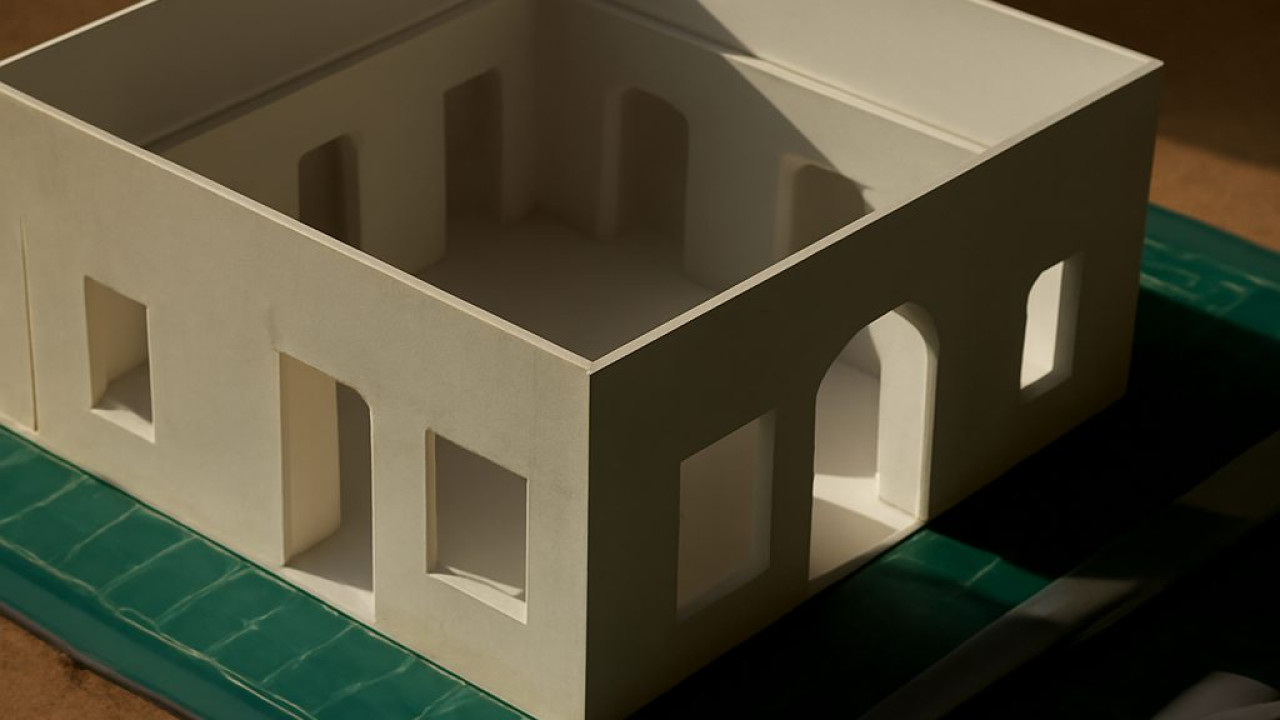
In architectural teaching the physical model has always done more than illustrate. Cutting card to scale forces decisions about thickness, joint and sequence that a drawing lets one defer, and the finished object can be turned, lit from one side, photographed from the height of an imagined eye. Its limitation is equally well known: at the scales a workshop can afford, the model is looked at from outside. The body remains a spectator of a space it is supposed to inhabit.
A model one enters
A digital model inverts that relation. Built from a plan, it is entered rather than inspected: the viewpoint descends to eye level and moves, and the angles, the heights and the light are those the finished room would have. Browser-based editors have brought this within reach of a seminar room with no software to install. Apokris turns a floor plan into a real three-dimensional scene, places furniture and lighting from a catalogue of manufacturers' products, allows finishing materials to be tried on the walls, floor and ceiling, and offers a virtual presence mode in which the space is walked through at full height. An existing drawing is not redrawn — DXF is laid under the plan as an underlay, STEP opens as a solid model — and for work in which light is the subject there is a professional lighting calculation for specialists, run on the manufacturer's own IES files and reporting illuminance on the working plane, uniformity, and the shadows cast by the furniture.
Two representations, not one
Nothing here argues for the retirement of card and glue. The two media fail in opposite directions, which is why they are worth holding together: the physical maquette is an object in the world and resists the hand, while the digital scene admits the body and surrenders the hand. A participant who has made both has been obliged to look twice — once at the place as a thing and once at the place as a condition of being somewhere — which is close to what the programme sets out to teach. The digital model is the second of those looks, and it is now the cheaper one to obtain.