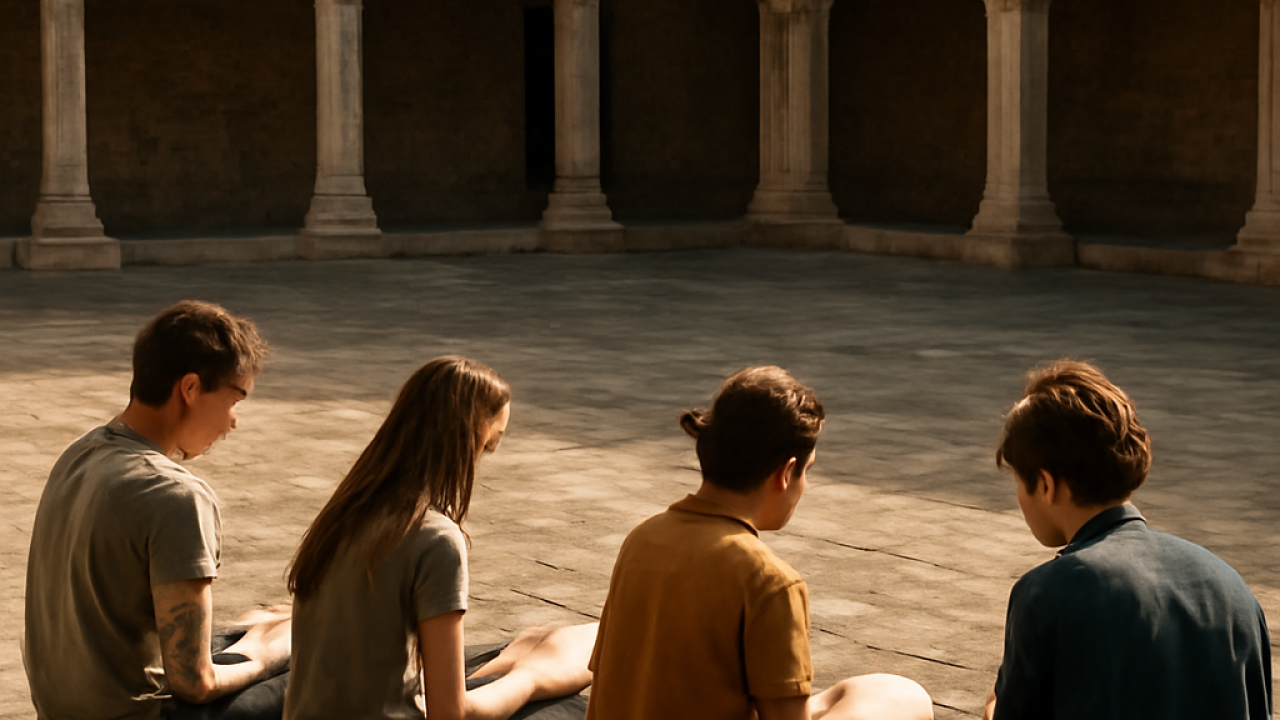
This workshop set out to combine a theoretical and a phenomenological approach to space and place, and in doing so to explore the boundaries between art, architecture and philosophy.
Its starting point is a simple observation: a space or a place is perceived with all of the senses, and that perception is shaped by what happens to us there. The programme therefore separates and clarifies four levels — experience, perception, creativity and representation — through lectures given by teachers from philosophy, architecture and art, and through the direct experience of two European cities, Rome and Venice. A visit to the Venice art biennale was added to the programme to deepen that experience.
Programme
The programme is built from theory sessions and visits in roughly equal measure, with an introduction followed by a series of lectures, and with both group and individual visits so that participants encounter the same spaces in different conditions. During the programme each participant represents their own perception of the places visited through photography or video art, which is then discussed by a jury of the teaching team.
The visits
Rome
Rome is at once a city and a special municipality, seat of the Italian state and of its Lazio region, and counts among the world’s global cities. Visitor rankings for 2014 placed it fourteenth worldwide and third inside the European Union, and within Italy nothing draws more people — a standing it owes to how much history, architecture and art is packed into one street plan. That density is exactly what makes it usable as a case study in how urban space is lived.
Cinecitta, Rome
A large studio complex on the edge of Rome, long treated as the centre of gravity of Italian film. It went up under the Fascist regime as part of an effort to put the national film industry back on its feet, and by the 1950s so many foreign productions were shooting there that the city earned the nickname Hollywood on the Tiber. Visiting it reverses the terms of the exercise: here is space constructed for a camera rather than for living in.
The Venice Biennale
An arts institution with its seat in Venice, whose name also belongs to the main exhibition it puts on. The art edition shows contemporary visual art and falls in odd-numbered years; it is the first of its kind, and the model from which biennials elsewhere were copied. The architecture edition takes up the scholarly side of the discipline, and at the same time gives architects and designers an occasion to put new projects on view, distributed across pavilions each with its own theme.
Bomarzo, the garden of wonders
“Just to set the heart free.” The Sacro Bosco — sacred grove, and known equally as the park of the monsters — is a Mannerist monumental ensemble at Bomarzo, in the province of Viterbo in the north of Lazio. It lies below a castle of the sixteenth century, and consists of sculptures and small structures scattered through the existing vegetation. Laid out in that same century, it was swallowed by undergrowth across the nineteenth and much of the twentieth, until a restoration campaign running through the 1970s recovered it. The garden is still privately owned and draws large numbers of visitors.
It was built to astonish rather than to charm, and its symbolism — as with much Mannerist work — is deliberately obscure. In one place a war elephant crushes a Roman soldier; in another a reclining figure of Ceres rests on bare earth with a vase of greenery balanced on her head.
At the end of the programme participants receive an official certificate of the workshop. No application form, contact details or fee information is published on this page.